Okay, this is just pure automobile fun… appropriate for the weekend I think.
Found this through Jalopnik.

Okay, this is just pure automobile fun… appropriate for the weekend I think.
Found this through Jalopnik.
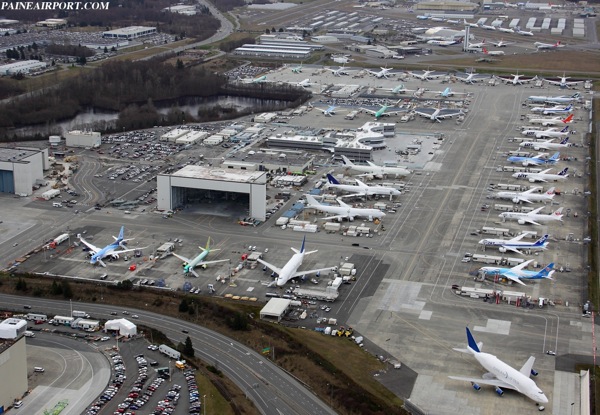
Photo by Matt Cawby. Matt has a slew of great photos on his Paine Field Blog as well as flickr.
Just a great shot that shows how quite a few 787’s piling up as production continues.
Megan McArdle says we aren’t going to see transcontinental high-speed rail in the US:
…we aren’t getting a national high speed rail network. Your wallet should be glad. But those of you who would really like to hurtle across the American landscape at 300 mph from Chicago to Las Vegas are permitted a small sigh.
I agree with her synopsis completely. In an optimized and efficient transportation network passenger rail (not high-speed) will fill metropolitan and regional travel needs. But transcontinental travel is the realm of airplanes and automobiles.
I think freight is entirely different though. Trains are the ideal for bulk hauling of commodities and fast, cheap shipping across long distances.
AAR’s summary of rail traffic for the first eight weeks of 2013.
Great piece by Derek Thompson at The Atlantic on the historical trajectory of airfare:
In 1974, it was illegal for an airline to charge less than $1,442 in inflation-adjusted dollars for a flight between New York City and Los Angeles. On Kayak, just now, I found one for $278.
Very cool innovation from Peugeot:
the Hybrid Air has a reversible hydraulic pump that uses the braking energy to compress nitrogen gas in what looks like an oversized scuba tank. When the Hybrid Air driver next presses the accelerator, the compressed gas pushes hydraulic fluid, syringe fashion, through a gearbox to turn the wheels.
Braking is one of the most wasteful aspects of modern transportation.
Cars and train dispose of braking energy by generating massive amounts of heat… all a waste. Planes using some conventional braking but largely just turn their engines into maximum reverse thrust to slow down… again all a waste.
One thing I love about recent trends in hybrid technology are the efforts to capture wasted energy. This hydraulic/air pressure systems seems very promising.
![xxx 05 ZTM 1192 [Warsaw tram] 17](http://farm9.staticflickr.com/8089/8521641441_f9fd5ea8a8_z.jpg)
Another photo from Howard Pulling (hpulling on flickr).
I really liked this photo with three different right-of-ways in one photo.
From the New York Times:
Japanese investigators, however, have maintained that there is still not enough evidence to show that the batteries themselves are the cause of fires, and that a shock could have caused them to overheat.
The Japanese have a vested interest in the batteries themselves NOT being the problem. The government actively subsidizes various industries involved with the 787 production including GS Yuasa, the maker of the Li-ion batteries used in the 787.
It should be interested to see how the FAA and Japanese review and approvals coincide with each other… or not.
From the New York Times:
Boeing is conducting laboratory tests on its proposed fixes for the lithium-ion batteries on its new 787 jets, and federal regulators said Tuesday that they would need to see the results before deciding whether to allow flight tests.
I’m a bit puzzled why the FAA gets to regulate test flights so tightly. If Boeing can show their test flight plan doesn’t take them over populated areas then shouldn’t they be allowed to assume the risk/cost of test flights? Maybe there is something I’m missing here.
Wyoming just approved a 10-cent per gallon hike in their fuel tax. It had pretty sweeping support… people will actually vote in favor of tax raises for obvious infrastructure needs.