Tag Archives: airport

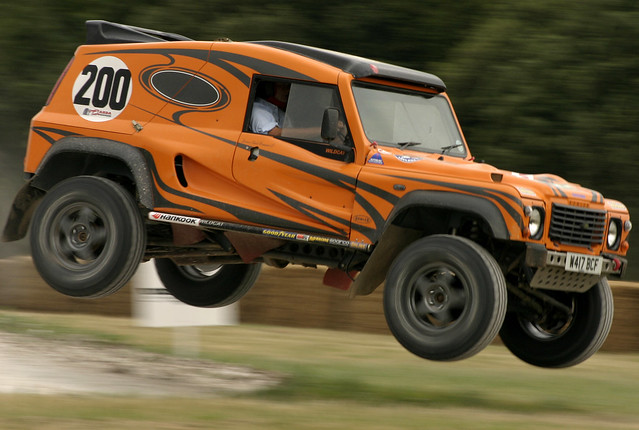
Photo – Bowler Wildcat

Bowler Wildcat

Photo by Alastair G (.photomotive on Flickr).

This heavily modified Land Rover D90 is simply an amazing piece of engineering. It was created with one thing in mind… winning the Paris-Dakar. It gets horrible gas mileage and only seats two, but that really isn’t the point. It’s one of the best off-road vehicles made and it’s street legal.

Top Gear has a wonderful 8-minute clip that showcases the Bowler Wildcat’s abilities.

Google Developing Driverless Cars

An older article in the New York Times on Google’s efforts at developing driverless cars.

I almost seems like the New York Times frames this as an admirable and benevolent activity on the part of Google. It’s pretty simply what there interest is in this… more searches and more clicked advertisements. If your car is driving itself, what activity are you likely to be engaged in while not driving? The internet is one obvious choice, and I’m sure Google will make that a very easy choice.

Driverless Cars

Nevada has taken a big step toward allowing driverless cars; they’ve authorized their DOT to start forming rules and regulations for the use of driverless cars.

I picked this up via Ben Brooks who raises a very salient point:

No matter how advanced sometimes you just can’t beat the human eye. Because the first time a ‘driverless’ car kills a kid in an accident that a human could have avoided — well that’s the end of the dream.

A real concern that every right-thinking person should have. I think the problem is that most people view the issue of driverless cars as an either/or situation. Either we all driver our cars everywhere, or we all have driverless cars take us everywhere. I think the reality would be a hybrid.

Imagine jumping in line on an onramp, pushing a button, and allowing the car to take over as it whisks you along safely on a grade-separated right of way amidst hundreds of other cars running driverless. All these cars could have their own onboard computer that would transmit simple information to each other to promote smooth flowing, high speed, safe traffic.

Now imagine, as your car takes you to your highway exit, an alert sounds letting you know you need to take over again. Once on the slower, mixed-use boulevards shared with cyclists and pedestrians, you have to do the work. You are still responsible to keep your eye out for the kiddo chasing their ball into the street.

Many folks are pushing for elimination of cars or at least a significant reduction in cars. Many of these same folks see a future of mass-adoption of mass transit. I just don’t see that happening quite the way some imagine. I think cars will long be an important part of our transportation infrastructure. With as much money as we’ve built into that infrastructure we’d be awfully wasteful to try and abandon that or replace it. Rather we should aim for making the automobiles themselves more efficient. We should also aim for more efficient use of the existing infrastructure.

Ending Ethanol Subsidies

The Senate voted 73-27 to repeal the $5 billion annual subsidy, just two days after rejecting an identical measure. The tax credit provides 45 cents a gallon to oil refiners who mix gasoline with ethanol, a renewable, liquid fuel additive that comes mainly from corn in the U.S.

The Senate voted last week to end $5 billion in subsidies for corn ethanol. This is a good thing.

I’m all for alternative fuels. I’m all for biofuels. But corn ethanol in America is a propped up industry that is raising the price of corn. This rise in corn feed is creating a rise in prices for other types of grains. The states is only seeing this through a few extra cents on a loaf of bread. But in the middle east (where I currently live) I’m seeing prices of bread double (the bread only costs a few cents in the first place).

Government subsidizing of corn ethanol has had so many unintended consequences it should have been stopped a long time ago. Let me name a few:

  • Grain prices are now tied to the volatility of fuel prices
  • The massive increase in corn planting (a row crop) is created more soil erosion
  • Row crops also allow a far larger amount of nitrates to entire the watershed
  • We need to be exploring sustainable forms of alternative fuels and biofuels. Boeing is doing just that.

    A final excerpt:

    The measure passed Thursday would end the tax credit immediately. It would also repeal a 54-cent-a-gallon tariff on imported ethanol, which restricts imports, mainly from Brazil.
    “The best way for ethanol to survive is to stand on its own two feet, without spending something we don’t have to get something we’re going to have anyway,” said Sen. Tom Coburn, R-Okla.

    Coburn nailed it. I sure hope this passes in the House as well.

    “Freedom from Oil”

    Representative Earl Blumenauer (D-Oregon) has released a report titled Freedom From Oil via the Livable Communities Task Force. This report further expounds on Problem No. 4 from our list, Dependence on Foreign Oil. The report also offers some potential solutions.

    High gasoline prices have once again demonstrated how dependent American households are on oil. Coping with road networks and development patterns that for the past century have been built to make driving the preferred and often only means of transportation, Americans are suddenly held hostage to a diminishing and increasingly expensive resource to live their daily lives.

    Indeed, the government has built a road network and actively promoted development patters that now find us tied to a volatile natural resource. So when is the government going to get out of the way? When are they going stop disproportionately funding road projects? When are local zoning commissions going to allow more mixed-use development? These problems are going to take time to solve.

    In the short term, I think that the continued volatility and rising of gas prices is going to help push research and development toward all-electric cars. Hybrids will ease the pain of rising prices, but all-electric vehicles will eliminate it. Such a shift would allow to continue using the infrastructure already in place as well. I think this trend is already starting with cars like the Nissan Leaf, Chevy Volt, and Toyota RAV4.

    American dependence on oil is not necessarily a result of preference as much as policy and investment in the infrastructure to create car-dependent communities.

    So many folks are often quick to blame our culture for our car obsession. People are “culturally attached” to automobiles. However, I think the above statement is the crux of the matter. Policy and investment in infrastructure make cars the clear choice for most people. Our subdivisions, schools, supermarkets, and malls are based on zoning structures geared toward driving to get from Point A to Point B.

    I’m a little disappointed with the Federal Policy Recommendations put forth in this report though. Most of them consist of more government-meddling. Government policy, partially due to the fact that Politics Trumps Solutions, often suffers the law of unintended consequences. That’s how we got to the point of car-focused policy and investment we are in now.

    A few of the better ideas:

    1. Continue to increase fuel efficiency of passenger vehicles, which could save drivers the equivalent of $1.00-1.70 per gallon of gas.
    2. Set clear national priorities for our transportation system, including a strategy and performance measures for reducing oil consumption.
    3. Promote Pay-As-You-Drive insurance, allowing consumers to pay less if they drive less.

    A good report. Well worth reading. I’m still polishing off the last of it.

    Personal Electronics

    An write-up on intercity bus travel at New Geography caught my attention with this tidbit:

    The growing prevalence of portable electronic technology, such as laptops and cellphones, gives intercity bus a new competitive advantage over air service and driving.

    As portable electronic devices become more affordable (wider adoption) I think you’ll see more impetus to get out from behind the wheel of automobiles. People will start asking themselves, “If I can travel in such a manner that lets me use my iPad to read/browse the web/watch a movie/play a game then why drive my self?”