Tag Archives: planes

Boeing and the Japanese

From the New York Times:

Japanese investigators, however, have maintained that there is still not enough evidence to show that the batteries themselves are the cause of fires, and that a shock could have caused them to overheat.

The Japanese have a vested interest in the batteries themselves NOT being the problem. The government actively subsidizes various industries involved with the 787 production including GS Yuasa, the maker of the Li-ion batteries used in the 787.

It should be interested to see how the FAA and Japanese review and approvals coincide with each other… or not.

FAA Keeping 787 Grounded

From the New York Times:

Boeing is conducting laboratory tests on its proposed fixes for the lithium-ion batteries on its new 787 jets, and federal regulators said Tuesday that they would need to see the results before deciding whether to allow flight tests.

I’m a bit puzzled why the FAA gets to regulate test flights so tightly. If Boeing can show their test flight plan doesn’t take them over populated areas then shouldn’t they be allowed to assume the risk/cost of test flights? Maybe there is something I’m missing here.

NTSB 787 Investigation

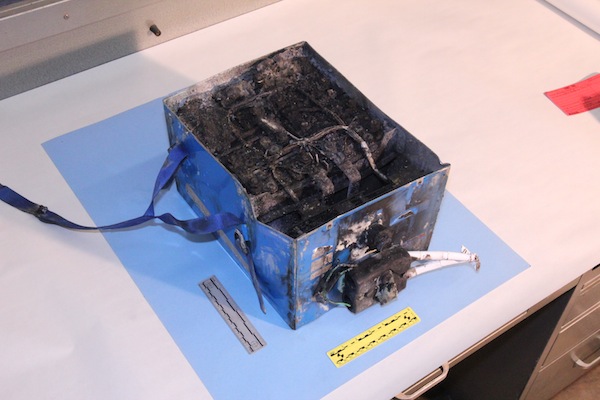
This is a photo of one of the burnt up batteries from the NTSB investigation of the 787 batteries.

JAL787 APU Battery

This is from the JAL 787 that caught fire on the apron at Logan International Airport in Boston.

You can read all about the National Transportation Safety Board’s investigation into the 787 battery issue on their website. They’ve got some relevant photos as well as interesting documentation.

They’ve even got a quick little primer on Li-ion battery technology.

Lahood’s Sucess

I’ve been ripping on DOT Secretary Ray Lahood a bit lately for his political brinksmanship. As he’s about to leave his post the Middle Seat Terminal blog takes a look at his record.

Now, airlines face potential huge penalties if they leave people sitting on grounded planes for more than three hours (four hours for international flights). There are exceptions for safety and air-traffic control situations, but the rule has clearly curbed what had been an ugly problem. In 2009, 868 flights were stuck on the tarmac at least three hours. The rule went into effect in April 2010. That year, there were 124 flights stuck three hours or more; in 2011, there were only 86, and in the first 11 months of 2012, only 73, according to the Bureau of Transportation Statistics.

This is a significant success and a huge help to the traveling public. Big thanks for this one Mr. Secretary.

787 Battery Fix

Boeing isn’t going into detail about the fix they proposed to the FAA, but Dominic Gates at the Seattle Times thinks it’s along the following lines:

  • A stronger, sealed containment box enclosing the eight battery cells
  • A system of venting tubes that in case of an incident would channel any flammable vapors or liquids directly out of the airplane
  • Continuous monitoring of temperature and voltage of individual cells within the battery
  • Better thermal separation of the cells, with some barrier such as high-temperature glass inserted between them

The article further explores the type of battery testing that may be required, moving forward, to satisfy the FAA and the Japan Transport Safety Board.