Time for another railroad photo.
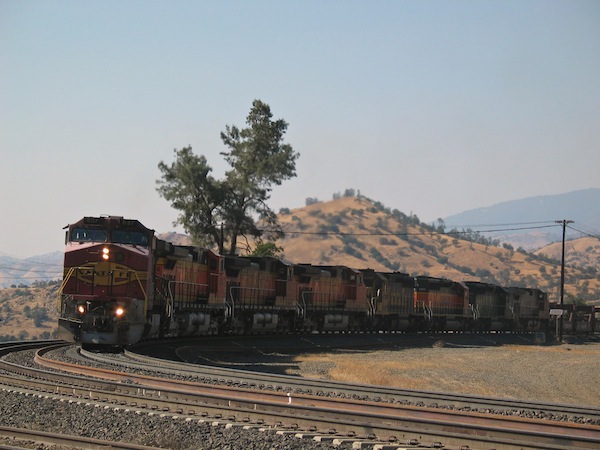
Back in 2006, while driving from Los Angeles to the Sierras, we stopped in to see if we could catch a train coming up Tehachapi Loop. We nearly missed this one.
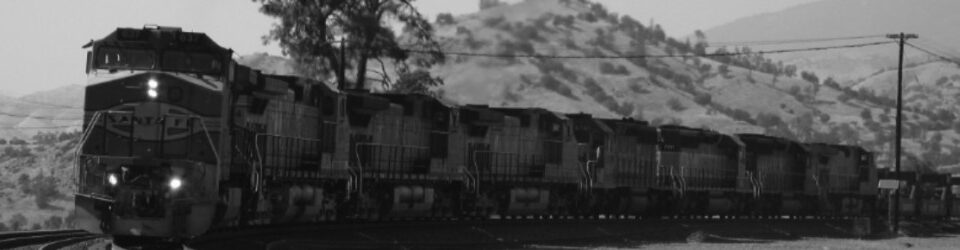
Time for another railroad photo.
Back in 2006, while driving from Los Angeles to the Sierras, we stopped in to see if we could catch a train coming up Tehachapi Loop. We nearly missed this one.
Dave Talley, superintendent of Norfolk Southern’s Lake Division, wrote a great op-ed in the Fort Wayne Journal Gazette.
The freight rail network has been a bright spot in a troubled economy. That’s because freight railroads, unlike trucks, airlines or barges, have been using private capital to invest in the rail network and facilities in northeast Indiana and around the country.
A small caveat here. The railroads do use some federal money through FRA grants that seem to generally be dispersed through state DOT’s. If you look through these grants though, the dollar amounts are a fraction of the capital that the railroads put into their own infrastructure.
All the same, Dave’s point is important. These private companies, the freight railroads, have shown amazing resiliency in the midst of economic problems. They aren’t waiting around for a bailout.
Even through the recession, railroads such as Norfolk Southern steadfastly have stayed committed to providing safe, reliable, efficient and affordable service, employing people in well-paying jobs that support families and communities.
Safe, reliable, efficient, affordable. Can we say these same things about our public transportation and its infrastructure? Not always.
…since 1980, freight rail industry has invested $480 billion to maintain and modernize the nation’s rail network so taxpayers don’t have to.
Looking ahead, these investments are not slowing down. In 2011, freight railroads plan to spend a record $12 billion of their own money on capital expenditures – on things like upgrading tracks, new fuel-efficient locomotives and new intermodal facilities.
Yeah, the $1 million and $5 million grants listed on the federal grants site don’t really touch the figure the railroads are fronting on their own.
Here’s a great idea with typically poor execution by the politicians. A vehicle miles tax.
The whole approach to this is wrong though. The White House issues a draft reauthorization bill that includes this idea but then promptly disowns the idea publicly. It’s like they are trying to gauge opposition rather than solve a problem.
First of all, if you are going to restructure the funding of road projects, you need to go all the way. Kill the gas tax. It’s not doing the job and, as it is, if we want to reduce gas consumption then gas tax revenue will be shrinking anyway. Remove the gas tax and replace it with a vehicle miles tax.
Secondly, why do we need to accompany this with a proposal for a spooky, big-brother-esque, tracking device in every car? Cars track their own mileage via the odometer. It’s already a Federal offense to tamper with odometers (see Motor Vehicle Cost Information Act, 49 U.S.C. Section 32704). Just require an odometer reading every year with vehicle registration. The States already have the resources in place to collect this information.
You are NEVER going to get people to accept an additional tax to pay for their roads. However, a substitute tax that presents a better funding structure and produces a tangible result (ie. better roads) will probably pan out. The number of miles driven, and thus the amount of demand placed on the infrastructure, will be proportionate to the funds collected.
The best solutions are often the simplest. What am I missing?
In an all-out effort to lower the cost of their hybrid offerings Ford has in-sourced (is that a word?) nearly all of its hybrid technology. Ford designed its own hybrid battery, which will soon start production in Ford’s Rawsonville, Michigan plant, as well as its own hybrid transmission, to be produced in Detroit.
Software development for the hybrids has also been brought in-house. The results? Costs on Ford’s newest generation of hybrids dropped by a cool 30%…
via Gas 2.0.
Speaking of hybrids, this is promising news. One barrier to hybrid car adoption has been the price premium. Make the price equal and you are on the way to a wider adoption of this technology.
I’m still not convinced hybrid is the endgame for automotive transport, but its certainly a step in the right direction.
Their new SkyActiv all-gasoline engine 2.0 liter, 155 horsepower will allow the 2012 Mazda3 to boast a hybrid-esque 40 miles-per-gallon.
via Gas 2.0.
Very interesting. I gotta admit that engines like these sure take the bang out of hybrids. In my opinion, hybrids just aren’t quite there yet. A diesel Jetta can beat out a hybrid… as could my 1987 Honda Civic SI that I purchased very used in 2004. I could pull 42 mpg out of that car.
Going back to the great article in The Economist I missed the diagnosis of another problem. The transportation infrastructure in the United States is decaying. Interestingly enough, this is a problem that seems to primarly plague public transportation infrastructure. The railroads are actually in good shape; maintaining high-quality right-of-way conditions on their own dime (ignoring the fact that certain projects receive generous grants). Toll roads also seem to do a good job of managing their own maintenance and operations.
You could argue, quite rightly, that this isn’t a problem in and of itself but rather a symptom of our funding structure and thr politic winds. However, it’s also a problem worthy of its own solutions so for now we’ll add it to our list.
To recap the problems:
I promise we are going to expound on these problems in the future. In addition we are going to start tossing around solutions.
I’ve got another item to add to our running list of transportation problems that need solving…
Dependence on Foreign Oil.
This could also be considered a symptom in many ways. It is a symptom of the fact that we use fossil fuels for so much of our transportation infrastructure. But I don’t think using fossil fuels in and of itself is a problem. I believe technology will eventually wean us off fossil fuels, but in the meantime it is an excellent form of energy. However, our dependence on foreign oil subjects us to pricing swings and supply limitations. I’d like to hear other ideas on this though. Is this a problem, or merely a symptom?
Our log of problems looks like this now:
Chalk this up as a further example of the fact that Politics Trumps Solutions. Ray Lahood is plugging the need for a highway reauthorization bill.
The head of the nation’s transportation system said during a stop in Charleston on Monday that Republicans and Democrats in Washington could come together this year to pass a major new transportation bill.
Secretary of Transportation Ray LaHood said during a speech to a group of transportation officials that the Obama administration viewed the bill as way to put Americans to work.
Highway reauthorization shouldn’t be about creating jobs, it should be about maintaining and developing our transportation infrastructure. It’s great that there is the possibility of job creation, but our transportation infrastructure has problems that need solving.
The Economist has a good look at our transportation infrastructure and (lack of) innovation. You should read the whole thing.
A few highlights:
These are symptoms. Symptoms of the problems plaguing our transportation infrastructure. It strikes me as self-defeating that the solutions being called for always involve more government. More taxes. More spending.
The article makes the following observations:
Petrol-tax revenues, for instance, are returned to the states according to the miles of highway they contain, the distances their residents drive, and the fuel they burn. The system is awash with perverse incentives. A state using road-pricing to limit travel and congestion would be punished for its efforts with reduced funding, whereas one that built highways it could not afford to maintain would receive a larger allocation.
and
Cost-benefit studies are almost entirely lacking. Federal guidelines for new construction tend to reflect politics rather than anything else.
Why then aren’t we looking outside the box? Let’s solve the problem, not band-aid the symptoms. The problem, in this case, is that Politics trumps solutions.
The article, however, does put forth some good solutions to the problem of disparate funding structures and the true costs being hidden.
Economists press for direct user fees. An early Obama administration flirtation with a tax on miles driven attracted little support, but some cities have run, or are thinking of running, pilot schemes. Congestion charges present another possibility. State governments have increasingly turned to tolls to fund individual projects, but tolling inevitably meets stiff public resistance.
Ah, now we’re talking. Use fees and tolls. Gas consumption fees do not correlate to road/transporation usage and costs. Pay for what you use. This, more than anything, will cause people to make the most efficient use of our resources and infrastructure.
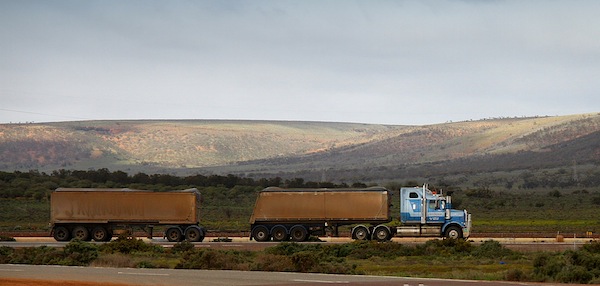
Photo by Nick (aka TRUCKPIX on Flickr).
“…finally made it to the Turnoff, end of the Eyre highway and I saw this Quinn Western Star heading south on the Lincoln Hwy.”