Author Archives: admin

Intermodal Growth

Interesting article on Reuters regarding the growth of intermodal shipping amongst the railroads. Fuel prices and trucking capacity issues are pushing freight onto the railroads:

“Rising costs on the truckload side because of increasing capacity scarcity, higher fuel prices, highway congestion, the increased (trucking) regulatory environment all help promote conversion from truck to rail,”

This got me thinking a little bit. Why don’t the railroads view themselves as full-on logistics companies like UPS, FedEx, and DHL? These logistics companies are also shipping companies… but they transport goods from start to finish. All three of these logistics companies operate their own trucking companies, airlines, and distribution centers. They have mastered the transportation of goods.

When it comes to intermodal the railroads do heavy lifting, but what if they tried to offer a service to also cover the “last mile” of shipping? BNSF ships a good amount for UPS, JB Hunt, Xtra Intermodal, etc. and lets them handle the “last mile”. Is there no money to be made off that last mile? What efficiencies could be brought to the transportation of freight if a railroad like BNSF purchased JB Hunt and provided integrated “door-to-door” service?

It seems like Union Pacific almost gets it:

“We see a possible 11 million truckloads of opportunity, meaning 11 million truckloads we could potentially convert from highway to Union Pacific,” spokesman Thomas Lange said.

The railroad recently bought 5,000 shipping containers, boosting its fleet 9 percent,

Why stop there? Don’t just buy shipping containers. Buy the tractors and trailers and finish the job? Provide fully integrated logistics. I’m sure they’ve looked at this. What am I missing?
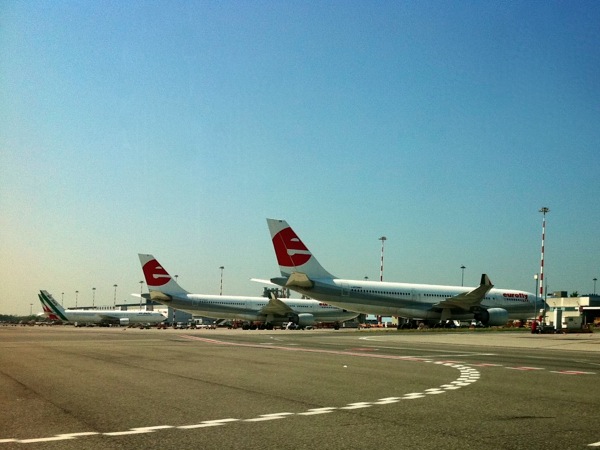
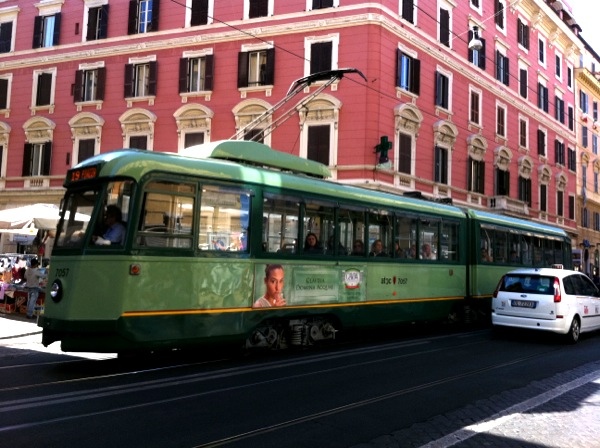
Photo – Milan Apron

Milan Airport
Planes lined up on the apron in Milan, Italy during a layover from our recent trip to Rome. They clearly don’t have enough jetways as it seems all inbound flights deplane on the apron.

We Need More of This

Burlington Chief Executive Officer Matthew K. Rose is determined to take advantage of the industry’s improved climate and the flexibility he gets by having only one shareholder—Buffett. This year, Rose is boosting capital spending by 31 percent, triple the increase of other major rails. He’s buying about 200 locomotives and building more huge transfer facilities where rail freight containers are switched to and from trucks before and after their transport by train. Rose’s goal: to bolster the second-largest U.S. railroad’s competitiveness relative to long-haul truckers.

via BusinessWeek.

Politics in Transportation Funding

Yonah Freemark over at The Transport Politic laments the broken funding structure of transportation projects:

But in a country where the vast majority of people drive to fulfill the majority of their transport needs, it would be politically untenable to suggest that most roads money be transferred to transit users.

True. We spend money on gas to fuel our cars. We pay gas tax when we fuel our cars. We expect that tax to better the driving environment for our cars. Pretty simple relationship.

Nonetheless, the American transport funding mechanism is routed in the user fee, a product of a certain logic that assumes that people should pay for what they use.

I disagree here. Our transport funding mechanism isn’t entirely rooted in a user fee… it’s rooted in a gas tax. If it’s a user fee then it’s predicated upon the wrong idea, that the good I’m using is gas. The reality is that I’m using infrastructure. Gas is my fuel, but when I drive from point A to B I’m consuming the infrastructure. I’m placing wear and tear on the infrastructure.

If I buy a Nissan Leaf I suddenly stop paying the gas tax… but I’m still consuming the infrastructure. If Doc Brown installs a “Mr. Fusion” unit in his Delorean he stops paying the gas tax… but he still consumes the infrastructure. That’s why a true user fee is a good idea. The logic “that assumes that people should pay for what they use” is the right logic. It’s just distorted through Disparate Funding Structures (one of our main problems).

Yonah finishes by throwing out two solutions to the funding structure problem:

But a right-headed long-term approach would require that either we pull the national government out of the transport financing game altogether, or that we pull away from the direct connection between highway user fee collections and spending.

I think he’s on the right track when he mentions pulling the national government out of the transport financing “game.” Such an appropriate word there. One of our other main problems, the fact that Politics Trumps Solutions, has turned our transportation funding into a game where the States are unwitting contestants in a sort of Survivor-esque reality show.

Now, how do we go about pulling the national government out of the “game?”

“Moving Things”

Another transportation blog I recently discovered, Cap’n Transit, has started an interesting series of articles on “moving things,” ie. freight hauling. You should read these little snippets. I especially appreciate some of the information and data he links to in these articles.

One quote caught my attention:

Reducing highway and fuel subsidies is one way to make the cost of trucking more apparent.

This is touching on a solution to one of our problems, the True Costs are Hidden. Fuel taxes (with generous help from the general federal budget) fund our highway infrastructure and therefore hide some of the costs associated with shipping freight or transporting people by car.

We need to reduce the subsidies to the highways and at the same time require shipping companies (and motorists perhaps) to directly fund the infrastructure they are using. This will put the different modes of “moving things” on more equal footing.

Amtrak’s $100-Million Trains

Fred Frailey did some digging and found some stupefying numbers for the yearly operations of select Amtrak passenger trains.

I’m old enough to not be frightened by big numbers. But I have to admit catching my breath when I saw what it costs Amtrak to operate three of its most popular and endearing trains. We’re talking nine digits.

via Trains Magazine.

I’ve had the opportunity to ride one of these trains, the Southwest Chief. For a nostalgic railfan like myself it was a great time. However, it took over 9 hours to travel from Chicago to Kansas City. This is not the model of efficient transportation. I suppose that’s further exemplified in the numbers Fred dug up… $103-million in costs, $62-million in revenue. There’s a reason the private railroads started dumping passenger service throughout the 1960’s… it was not tenable. Apparently it still isn’t.