Tag Archives: airport

Highway Reauthorization a “Jobs” Bill?

Chalk this up as a further example of the fact that Politics Trumps Solutions. Ray Lahood is plugging the need for a highway reauthorization bill.

The head of the nation’s transportation system said during a stop in Charleston on Monday that Republicans and Democrats in Washington could come together this year to pass a major new transportation bill.

Secretary of Transportation Ray LaHood said during a speech to a group of transportation officials that the Obama administration viewed the bill as way to put Americans to work.

Highway reauthorization shouldn’t be about creating jobs, it should be about maintaining and developing our transportation infrastructure. It’s great that there is the possibility of job creation, but our transportation infrastructure has problems that need solving.

American Transportation Infrastructure

The Economist has a good look at our transportation infrastructure and (lack of) innovation. You should read the whole thing.

A few highlights:

  1. According to the World Economic Forum America ranks 23rd for overall infrastructure quality.
  2. America’s road fatality rate is 60% above the OECD average.
  3. Total public spending on transport and water infrastructure is 2.4% of GDP
  4. In 2006, road taxes at all levels only provided 72% of the money spent on highways

These are symptoms. Symptoms of the problems plaguing our transportation infrastructure. It strikes me as self-defeating that the solutions being called for always involve more government. More taxes. More spending.

The article makes the following observations:

Petrol-tax revenues, for instance, are returned to the states according to the miles of highway they contain, the distances their residents drive, and the fuel they burn. The system is awash with perverse incentives. A state using road-pricing to limit travel and congestion would be punished for its efforts with reduced funding, whereas one that built highways it could not afford to maintain would receive a larger allocation.

and

Cost-benefit studies are almost entirely lacking. Federal guidelines for new construction tend to reflect politics rather than anything else.

Why then aren’t we looking outside the box? Let’s solve the problem, not band-aid the symptoms. The problem, in this case, is that Politics trumps solutions.

The article, however, does put forth some good solutions to the problem of disparate funding structures and the true costs being hidden.

Economists press for direct user fees. An early Obama administration flirtation with a tax on miles driven attracted little support, but some cities have run, or are thinking of running, pilot schemes. Congestion charges present another possibility. State governments have increasingly turned to tolls to fund individual projects, but tolling inevitably meets stiff public resistance.

Ah, now we’re talking. Use fees and tolls. Gas consumption fees do not correlate to road/transporation usage and costs. Pay for what you use. This, more than anything, will cause people to make the most efficient use of our resources and infrastructure.

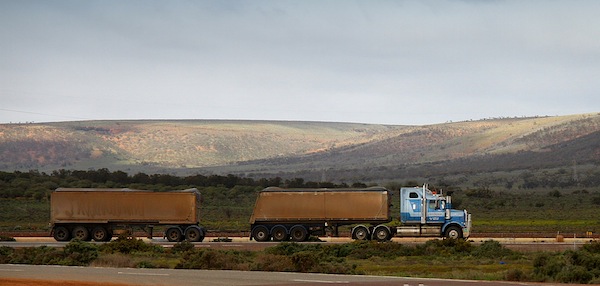
Photo

Truckpix001

Photo by Nick (aka TRUCKPIX on Flickr).
“…finally made it to the Turnoff, end of the Eyre highway and I saw this Quinn Western Star heading south on the Lincoln Hwy.”

Gas Taxes

Gas taxes. Why do we tax gas? To place a “penalty” on the consumption? To create an incentive towards reduced use, ie. reduce demand? To fund transportation projects? To encourage R&D for alternative energy? To fund R&D for alternative energy?

The answer used to be simply to fund transportation. Now, in spite of the US being in the midst of inflation and rising oil prices, folks are picking up the gas tax or “carbon tax” as a way to reduce our demand and fund alternative fuel/energy research and develpment.

Mind you, the gas tax is already woefully incapable of funding all the road projects out there.

Kevin Drum asks “Why not tax carbon?” On the one hand he asks,

“what better way to fund energy research than with a carbon tax?”

It would be nice to believe that this carbon tax revenue would be placed in a piggy bank only for use by those doing R&D on alt-fuel. In the next paragraph though, he states

“Given that we’re quite obviously going to need new taxes in the future, I have a hard time seeing the downside of a carbon tax.”

This last statement kind of implies that this carbon tax (ie. gas tax) would really just be additional taxation to be lumped into the general pool. And knowing our government, that’s true. Politics trumps solutions.

A couple problems with the carbon tax:

  1. Raising taxes on gasoline is regressive. It takes proportionally more from those of lower income. You hurt those at the bottom… those who can’t afford a new Prius to offset the new gas prices.
  2. This doesn’t solve our funding structure problem with transportation. If anything, it just makes it more of a goobledygook mess.
  3. This is just going to end up another revenue generating tax that never goes away.

The only problem this may solve is our dependence on foreign oil. However, Drum himself points to studies showing that incremental increase in gas prices (such as though wrought by taxation) do little to curb consumption ie. reduce demand.

Before we starting adding a carbon tax to our fuel, we need to fix our transportation funding structure. We can look at ways to add disincentives to gas consumption later. However, I think that the real way you reduce gas consumption is by switching traffic (freight and passenger) to transportation that is grossly more efficient (rail comes to mind).
Flat Fee for Electric Cars?

How can lawmakers create a new system to maintain the transportation infrastructure that “makes more sense than what we have today?” Rep. Chris Reykdal asked.

via Wash. considers annual flat fee for electric cars.

Now here is a politician asking a smart question.  The question itself shows that this guy understands the unbalanced funding problem our transportation system has.  A flat fee for electric cars will only exacerbate that problem.